The problem is that seawalls are very expensive and make the problem worse for your neighbors. If you build a sea wall, you break the natural process which replenishes sand on the adjacent beaches and they’ll shrink and disappear.
The real solution is to accept that anyone who bought in the last half century should have factored in the scientific evidence of climate change and not expect taxpayers to subsidize their failure to plan appropriately.
At this point, the window for easily dealing with the problem is long closed and we should be prepared to write off high-risk areas: give the current residents support for moving somewhere safe and turn the land into a preserve where we can let the local ecosystem recover. A lot of beaches around the world have involved clearing things like mangroves which improve storm resilience, too, so restoration would help everyone further from the shore.
> The real solution is to accept that anyone who bought in the last half century should have factored in the scientific evidence of climate change and not expect taxpayers to subsidize their failure to plan appropriately.
It's mostly not even climate change. The reality is that without a great deal of very expensive intervention from humans, sand coastlines are constantly shifting and changing. Building long term structures in these places has ALWAYS been folly.
The worst part is it's not even irrational because the rest of the country will fund the billions of dollars for state and federal projects to shore up these properties indefinitely.
Let me amend that: it’s not just climate change but climate change is like a catalyst for the existing problem. Higher sea level, greater storm intensity and frequency, and other ecological impacts (e.g. native vegetation might not control erosion as well due to changing conditions or invasive pests) all mean we get the harder versions of the problem and have deal with more crises at a time.
Its more like this was inevitable regardless of climate change on the time period the average housing stock lasts, so building there and expecting this to stay as is was inevitably stupid regardless of climate change.
Higher sea levels are a good counter example to your point. Nobody thinks of normal housing lasting the thousands of years that process takes when you are think in terms of ice ages and warming periods, but a relatively modest rise makes a big difference when you’re thinking about things like how much a given house is exposed to storm surge.
Similarly, forest fires are always a risk but the fires are bigger, more frequent, and hotter when climate change had been drying out previously wet regions. That means society needs to plan for huge increases in response capacity in much larger regions than previously was the case, so again while it’s technically possible for there to be a fire anywhere those are very different situations from the prospective of everyone on defense.
Think of it like the way armies had to change going from flintlocks to automatic weapons, only we’re doing it much faster and are going to have to make hard sacrifices.
The reality is that climate change is resulting in 100 year events becoming 10 year events. Yes, the barrier probably would have been washed away _eventually_ irrespective of our changing climate, but sea levels are rising (104mm since 1993) and the frequency and intensity of extreme weather events is increasing. Everything that is now happening occurs in the context of our destabilizing climate. Given this, I'm not sure how supportable it is to declare that climate change is not, at the very least, a contributory factor in events like these.
Or you know, maybe people are too stupid to estimate probabilities like that. Our history is too short to really know what is normal and what is out of line. In geological terms, we are still very much coming out of an ice age and far from peak temperatures that we know have happened before.
> In geological terms, we are still very much coming out of an ice age
In geological terms, AGW aside, the earth was still very much within the Late Cenozoic Ice Age and has been for 34 million years.
In glaciation terms the earth was swinging out of an inter glaciation period and due to return to glaciation and decreasing global tempretures and increasing ice coverage.
Thanks to human activity increasing the insulation attributes of the atmosphere mean tempretures are increasing and global mean tempretures will increase past what we (as a human species) have experienced in our brief time on the planet.
> far from peak temperatures that we know have happened before.
It's true - we're a long way from living on the surface of a near molten ball of rock with no breathable atmosphere, as the earth once was.
Ok you got me. I meant in the last few hundred million years it has been way hotter than today. Life existed and thrived back then as well. We are coming out of an ice age and temperatures must necessarily increase as a result, regardless of any presumed impact humans have on that process. This may be interfering with estimations of the impact of CO2 on our atmosphere. I'm not claiming to be an expert on this but I am skeptical of people who claim to be experts on this, as alarmism inherently boosts their careers.
Hate to break it to you, but humans are not stromatolites.
Humans have been about for two million years and have evolved to live in recent climatic conditions and to thrive in the extremely relatively stable Holocene.
> We are coming out of an ice age
On what evidence?
By the record we are in an ice age (do see and read my prior link) and not only were we expected to stay in that ice age but were expected to return to increased glaciation (ie decreasing tempretures).
The only reason we are coming out of an ice age is due to human activity increasing the bulk insulation properties of the atmosphere.
> I'm not claiming to be an expert on this
I've spent four decades in geophysical exploration developing instruments and software for mapping earths energy and mineral resources for extraction.
I'm also not claiming to be an expert but I have some exposure to continent and global scale modelling of gravity, radiometrics, magnetic fields, tidal movements, drift, etc.
This page has some good general information that you ought to be aware of before talking to people about this topic: https://www.ces.fau.edu/nasa/module-3/temperature-trend-chan... In short, the planet's temperature shifts wildly in geological time, even in a human time scale. Our written language and species may eventually survive long enough to convey all of this information past the next ice age, whenever that is to happen.
>The only reason we are coming out of an ice age is due to human activity increasing the bulk insulation properties of the atmosphere.
The climate is naturally cyclical, as explained in my reference above and many other academic sources. Again I'm not suggesting there is no human impact but that this may be difficult to isolate, no matter how confident various researchers claim to be in their models. We humans have lived through an ice age only 20k years ago and that ice age has been ending ever since, and not because of us. As an armchair geologist you should know about that as well as the Little Ice Age much more recent than that. This looks interesting: https://www.history.com/news/ice-age-human-survival
>The real solution is to accept that anyone who bought in the last half century should have factored in the scientific evidence of climate change and not expect taxpayers to subsidize their failure to plan appropriately.
Glad someone said this. If you got money to buy properties at Martha Vineyard, then how much do you really believe in climate change? People who build there should just accept the risk that their properties will be destroyed with little notice.
That's only one problem... The bigger problem is something you hit at, which is mass ignorance of complex topics that end up getting turned in to political sound bites. At least 30 years ago, and probably longer you could pick up books on bathymetry and arenology that described the physics of the situation and really gave dire warnings. Without adding things like rising sea level, the moment you start building near the beach bad things start happening quickly. Tall building interrupt wind currents, these wind currents change the shape and angle of the beach. Changing the shape of the beach changes the how waves scour the sand off the beach and leads to rapid erosion. This leads to people building sea walls, which just moves the feedback loop out a bit. What typically happens without constant replenishment is the ocean will continue to get deeper directly up to the seawall (losing your prime tourist attraction) until the seawall falls over.
A seawall is how you turn a million dollar problem in to a billion dollar one.
At the end of the day human ambitions and the ocean are not really compatible. We like to think we can tame anything and exploit its resources safely and cheaply. To use a bad analogy, it's like seeing a beautiful unicorn and capturing it because you love the way it looks. But after you capture it, its bright white coat grows dull and grey. It's horn falls off. It gets tons of medical issues requiring more and more expensive treatment. Suddenly everyone is claiming it's a ripoff and you never had a unicorn in the first place.
There's definitely a significant amount of "leopards ate my face" going on here, but I think a fair few people simply don't know better. They see a beautiful beachfront property and when the weather is good, it's all hunky dory.
But then a hurricane moves in and levels everything to the ground, and the real estate agents neglect to mention that this will happen on a regular basis.
Another weird one I’ve heard are people saying it can’t be that bad if insurers cover it, followed by dismay when the premiums double multiple years running.
I think the solution will end up involving some changes to federal disaster aid: FEMA will give you relocation assistance if you sell your house to BLM to become part of the coastal buffer reserve.
A sea wall performs much differently than a properly sloped structure. There are different engineering approaches to this problem and they function well when in place.
That said, it's a waste of time, money and resources.
In the 1950’s Lake Michigan had a similar problem. Academics at MSU measured the sand volume over time and realized that the amount of sand was receding quickly.
So they took on a massive project to plant marram grass all along the lakeshore. This takes several years to mature, however once it does the roots grow deep and the sand stays in place for a much longer period of time.
I am not sure what this community can do now, it feels a little too late. Maybe build a temporary sea wall, plant grass to hold the new sand, then remove the sea wall?
It's because they're doing a shitty job of restoring the dunes. If you dump a ton of sand of course it's going to be washed away. There's literally nothing keeping it there. If they want to keep a dune there they have to rehabilitate the whole dune ecosystem and part of that is having an ecosystem between them and the ocean. If there were plants established and holding onto the sand they wouldn't be washing away in three days!
Massachusetts literally gives a guide for this shit but these idiots are just DUMP MORE SAND THIS TIME IT'LL WORK!
Or to say it another way, they are spending $500k on a $5+ million dollar problem that requires buy in from a huge number of people over a long distance and to change behaviors of people using the beach to ensure they don't kill any plants and mitigations.
Or eminent domain the properties nearby and make people move to someplace where they won't be washed out to sea like that sand was. Unlike the perpetual sand bill, it's a one-time cost for ME.
Elmer Sands on the UK south coast, was badly affected by erosion. Authorities built a series of elongated rock islands parallel with the shore (visible here [1]). These a) protect the shore from wave damage, and b) encourage the build up of sand behind them, ie between them and the shore. Yes, there is still erosion, but you can better control where it happens and who it affects.
The houses are getting swept out to sea. The pace may have increased in recent years but this has been a fact of life on the sandy beaches of MA for centuries.
I was more interested in the comment that more permanent sea wall structures are prohibited. Maybe the residents feel like if their hands are tied then the government doing the tying should help? I don’t really know the local politics or reasoning though.
I agree, but to be fair it was also the state that limited them such a silly option. They can't do anything more permanent than sand. Which, I understand has an environmental impact, but the beaches are going to keep eroding so why not "draw a line in the sand" so to speak and help protect the beaches more permanently. Regardless of how lives there now.
* I live in the state but no where near the water. So I'm sure my taxes will be paying for this.
The shape of the shore is an equation. In it you have have a massive pool of energy that is the water and its currents. You have a second smaller, yet still massive in human terms, pool of energy in the wind. Then you have the slope of the land from a few miles on shore to many (maybe even hundreds of miles) offshore. This is the lever of the machine. It weighs billions of tons and is miles long. What exactly does permanent mean when you stick something between an anvil and hammer that grinds down mountains. And in specific, you stick it where it becomes the focal point for that energy?
That is why I said more permanently. 10 years is better than 72 hours. To say "get rid of the houses" as a solution to beach erosion without considering legal, social, and economic implications is a classic case of oversimplifying a complex problem.
At some point the bill needs paid, and like all moral hazards, this is one that foots the bill to someone else in the meantime.
Physics doesn't care about the dumb economic/political decisions you made in the past. Pushing it 10 years just creates 10 more years of damage to yourself and others and burns money the entire time.
You're acting like you can just science/money your way out of a problem that has grown massively over the last 70 years, but we no longer can. The bill is due with interest. Yea, you can roll over the debt if you want, but the house of cards falls down eventually.
Well, it's government regulation that keeps them from building a more rigid structure. I'm not sure it's that unacceptable to ask it to help, after they did their best within the regulated framework.
Yea, it's like the government knows the problems induced by rigid structures near the ocean and most people have no clue because they "want what they want" and have never picked up a textbook to even begin understanding the damage they are causing.
I don't know, in my place (the West coast of France) it's the government's job to protect citizens property.
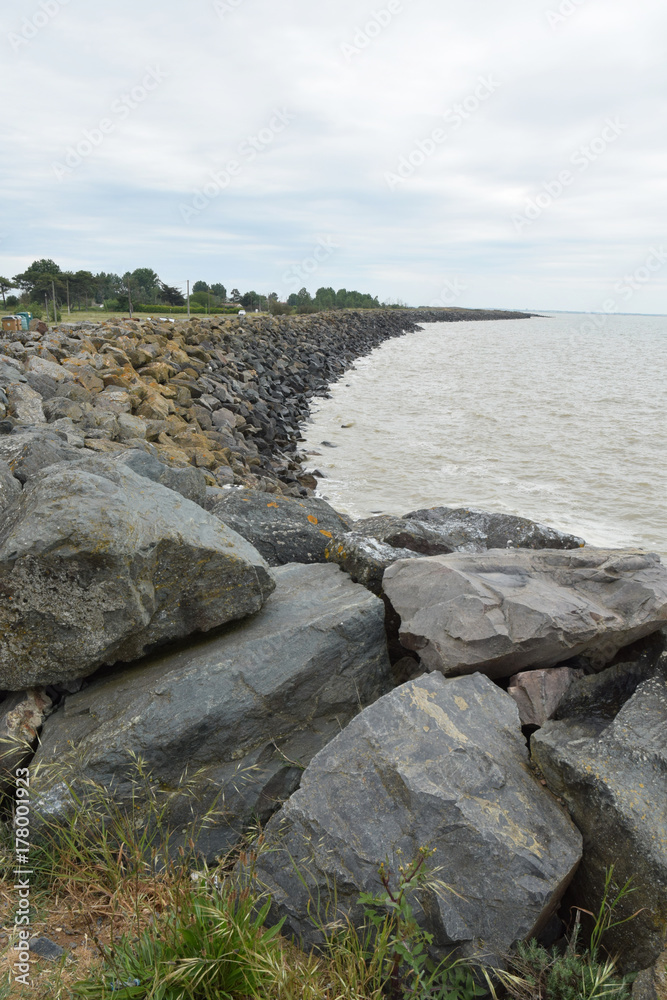
There used to be a dike built in 1856 but it eroded away and in the 90s when I was young the broken sections were replaced with just big rocks[0]. It works quite fine, I believe they wouldn't count as a "hard structure" which is forbidden in this case, and they don't wash away like sand. Beaches form, naturally or with wave breakers, at the foot of the dike like they did before.
But I really don't understand why individual homeowners would be expected to conduct public works themselves like building dikes.
Were they illegally built without a permit? Then they should be demolished. Were they built with a permit? Then either it wasn't obvious they shouldn't have been built (and then why would the homeowners be responsible for these kind of works?) or there was corruption (and then the relevant persons should be condemned). But privately built seawalls to protect the coast? That seems out of proportion, and unlikely to produce positive results on the long term.
In the same area I'm talking about, people died in flooding during cyclone Xynthia, in 2010. It wasn't because of a particular weakness in the seawall, it was found that these homes should never have been built in the first place.
But they had been built legally, with permits obtained from the town, so 700 of these homes were bought (by the state, not sure exactly which levels the funds came from but France is a unitary state so it doesn't matter much) and demolished. And the mayor who granted the obviously bogus permits was sentenced to prison for the 29 deaths he caused.
In theory, yes hundreds of billions (maybe trillions of dollars) in houses and building need purchased and destroyed in the US.
This will not happen. Houses/businesses near beaches tend to be of higher value and owned by the more politically connected. Any political talk of "We're not going to insure it and we'll let it fall in the ocean" means new people getting elected next election.
It's also worse than that in the US. We're permitting and allowing things that will fail, and have no means of funding those costs of buyout or replacement in the future. As long as people remain ignorant and keep voting themselves largess the cost of the problem will continue to grow.
The houses were built 100 years ago, when the ocean was hundreds of feet further away. If you asked the builders, I'm sure they would have told you that this would happen in a century or so. Erosion of sandy beaches isn't a surprise.
I agree with your sentiment, but you missed half the article if that was the last sentence you read. You quoted the last sentence before an ad. The article continues below the ad.
1. Deregulate / reregulate to where residents are allowed to build a seawall instead of sacrificial dunes.
2. Bring in the Army Corp of Engineers to help with design, planning, and evaluation.
Things which don't make sense to me:
1. Blocking people from doing the work.
2. Funding the actual construction with state or federal dollars.
This is not an isolated problem. The Army Corp of Engineers should have the knowledge, skills, and abilities to plan this well. Assisting in projects like this is how you develop that skill set.
The problem with diverting water is that it goes somewhere else. The issue is that Salisbury is in the way of the ocean. Trying to build your way out of that is not going to work. They could establish an annual sand budget and treat it just like snow removal.
I'm not sure water needs to be diverted, per se. The problem isn't baseline water level but waves, and especially large waves, and sand washing away. It seems like the solutions would involve some combination of:
* Breakwaters, to equalize the water levels and reduce the waves
* A few meters inland, some kind of wall (firmer than sand) which doesn't wash away, so a bigger wave doesn't impact homes
* Perhaps some kind of reinforcement underneath the sand
It might reduce littoral drift a little bit, but as I understand, this would be done the length of a rather long coastline, so that's not really an issue.
I have very mixed feelings about just dumping tons of sand into the ocean each year. That's going to have its own impacts.
You seemingly don't understand the costs and long term effects of what you're asking.
Just dumping sand on the beach is positively cheap compared to the hundreds of millions you're asking for. Also, building a wall near the ocean is possibly the worst idea you could ever do. Please research the interaction between air, water, and sand to learn this is how you make a massive hole that swallows everything. The same is true with breakwaters. Constant refurbishment is needed, and it changes sand flows that affect other people.
This seems like the sort of problem we ought to learn to solve. That's why I'd like us to try things, and I'm happy to have a little bit of my tax dollars involved. This problem will only be more and more common.
If you want a book that directly faces the problem look at "Pitfalls of Shoreline Stabilization: Selected Case Studies".
Of course you'll want to balance that out with books that just talk about the general challenges and successes, in which I'd recommend just looking at books.google.com on writings by the US Army Corp of Engineers. They talk about practical mitigations for different types of erosion.
Most success stories are going to be based on things like using plants/growth to trap and build sand, which typically means lowering human access to the beach and ensuring tall things that interrupt wind flow are not near the beach. For example mangroves in climates that allow them to grow.
There are also plenty of examples poing out by the C of E on things that cannot be solved. If you built a city near a portion of the beach that was eroding long before humankind appeared in to the picture, all you can do is slow that erosion and at great expense. The ocean is far more powerful than you can imagine.
I don't think the Army Corp of Engineers should be wasting taxpayer dollars on this either. Zero federal taxpayer dollars of any kind should be going to building in the way of the ocean just so people can have a beach view.
If people are actually living in the at-risk properties as their primary residence, I'd support spending taxpayer dollars to help them move.
> Property owners dumped 15,000 tons of sand in a Massachusetts town
to fend off dangerous tides, but it was swept away in 72 hours
The assistance they could benefit from most is not financial but a
short educational course on basic construction science. Sand is not a
great building material. It even mentions that in the bible (Matthew
7:24-27).
I did read the article and it was still a stupid thing to do. It was
stupid with or without government approval and it was stupid whether
or not I read the article. What was your point?
I really despise the EPA. They have moved beyond their original charter of protecting the environment to protecting the property of some rich people at the expense of others--including poor people. I bet there's places in Massachussets that has similar properties but are the 'right kind' of rich people so they get variances. And by right kind, I mean people who have generational wealth and not just wealth that was earned by years of hard work like most shore town home owners.
If you’re betting against the ocean, half a million bucks seems like a piddling small amount to bring to the table.
Like, so small an amount that you probably shouldn’t be allowed to play the game.
Part of why you have table stakes is to keep small players out of the game, and the ocean is maybe the biggest, most powerful player in the largest game on earth. (Metaphorically speaking, of course.)
There is a method of sand nourishment that works for much longer time, the sand engine. But you're talking about $10 million for a small one. The first one constructed was 70 million euro.
$500k does seem to little to play this game.
Looks like our carbon footprint actually is defeating the ocean’s ability to absorb it, via the phyoplankton and the acidification results in massive changes.
The ocean isn't going to disappear due to global warming. It'll just change and rejuvenate itself long after we're gone. The ocean is the house, and the house always wins.
Eh, the ocean is just moisture on the outside of the rock, it seems like a big deal to us because the rock itself is so enormous we just forget its there. There is so much rock that just by existing it exerts a powerful force on us all the time and we just don't even think about that.
It's so enormous that we don't know for sure what's inside it. It's very hot in there, and radioactive, and generally hostile to life as we know it, but we've barely scratched the surface, we haven't really tunnelled much deeper into the rock than the thin layer of moisture you're making a big deal about, which is essentially nothing - a few kilometers. The rock is like twelve thousand kilometres across.
They have been "at war" with water for centuries now. Several floods have occurred, the last major flood was in the 1950's, IIRC. For the most part they have managed to keep the water out, but I wouldn't consider their battle fully settled yet.
1. They spend something like 1.5% of their GDP so they can double the size of their country. This works ok for small countries, but not large ones (think more of city protection for larger places).
2. This will eventually get them sued in international court when one of their projects affects surrounding countries. The ocean is filled with butterfly effects.
1. If a bully shows up and tries to beat you up, so you hit him in the face. You won, right? But what if we comes back tomorrow and tries again. What if he never stops coming back every single day forever. You have not won. At best you are in a stalemate in which you have to keep up the fight pouring massive amounts of money and effort into your game otherwise catastrophic outcomes (https://en.wikipedia.org/wiki/North_Sea_flood_of_1953)
2. If in that fight you shift the burden of the fight on to your neighbor, you're just an asshole, not a winner. And you're still caught in the loop of point 1.
> 2. This will eventually get them sued in international court when one of their projects affects surrounding countries. The ocean is filled with butterfly effects.
That's bizarre. Do you really think the Dutch will at some point get sued because of the dikes they have built to keep out the water? Maybe somebody should warn them, I can assure you that nobody in the Netherlands has ever considered that possibility ..
I was curious on some of the details, so I did a little digging.
The town in question (Salisbury, MA) is built on a narrow strip of land between a marsh and the ocean. Mostly between 2 and 5 houses wide. Doesn't seem like you need a geology PhD to determine you're going to have some erosion problems here.
As best I could determine, the beach replenishment in question was from access points 5 - 11, which covers 1.6 miles and about 150 homes. If I'm right on that, they put down enough sand to extend the beach 3-7 feet[0]. So the first thing to note is that this was a very small beach replenishment project. The senator is probably right that they should go bigger next time.
The cost per home for that would have come out to about $3333.33. Honestly, even if you triple it and do it every year, I don't find that to be an unreasonable expense to impose on owners of $1-5 million houses built on a sand dune. These guys need to quit whining and raise their _local_ taxes the relatively modest amount necessary to preserve their town. Something like $5k/year for beachfront and $1k/year for the rest would get the job done.
[0] This is assuming a constant slope to the beach. The low end is extending at 3 feet above sea level, the high end is extending at 6 feet above sea level.
I don't have evidence for this, but my suspicion is that the sand was not supposed to be long-term, but just to look impressive for suckers while the owners dump their now worthless real estate.
If you want pristine sand beaches then expect major change over time. Looking at areas where there is little change over time, certain coastal structures are in plain sight.
But as many have already noted, the sea erodes all coastlines. However, what the sea takes away at one time, it also brings back in another time. When my father was in his teens, the water's edge for a small residential site was over a mile away. By the time I was in my teens, that distance had been reduced to 30 metres. By the time I was in my late twenties and early thirties, the water's edge was now at half a kilometre further out. Since then (I'm in the mid 60's) that beach has has grown and receded a couple more times.
Moral of the story, build only where there is relatively constant conditions.
This is not a solution. These things work great for protecting particular objects, but they don't protect beaches. In fact they do the opposite and destroy beaches.
So instead of a beachfront house, you now have no beach and a big 'rocky' ocean front that is dangerous for people to use and must 100% keep off of.
>Tarr, noting that a more permanent seawall was not an option because hard structures like these are not allowed on Massachusetts beaches, said: “We’re managing a natural resource that protects a lot of interests.”
The interests of the wealthy.
When rich people make mistakes, they rarely suffer the consequences.
That is why they can arrogantly build housing along beaches without a thought to the outcome.
I on the other hand am forced to use my limited resources paying for their mistakes - whether they build homes on the beach or overinvest in commercial real estate.
The take away for me was that policy needs to change. Massachusetts prevents hard sea walls. Long term that seems like the only solution. Or people move away from living directly next to the ocean given that it is going to be a constant money sink for society so a small % of the population can enjoy a view and lifestyle unavailable to the people paying for it (presuming the state assists them in dumping more sand, or eventually constructing a sea wall).
>Massachusetts prevents hard sea walls. Long term that seems like the only solution.
Depending on your definition of long term, the ocean always wins. Sea walls destroy the beach and environment. We have to decide what we're saving here, you can't save both.
> the volunteer organization behind the dune project, said on Facebook that even though the expensive protection mechanism was destroyed within days, “the sacrificial dunes did their job”, arguing that much more could have been destroyed were it not for the presence of the dune.
Either that, or the sand dune project was a result of their own gross incompetence
Entire island states like Tuvalu face a similar fate and they have nowhere else to go... I know it's unrelated to this particular situation but the sea is the sea and doesn't care much about a costly sandy bump. Yes, the Netherlands managed to pull some tricks but the site is different and they used hard structures anyway.
Honestly at this point Tuvalu should use the money it makes from the .tv domain (and otherwise) to relocate and buy some vast farmland abroad. It's sad to see the state of affairs some islands are in. That's one kind of refugee immigration I could back. Just 11,000 people.
"sea levels rise due to thermal expansion" ... It is a contributor but not the leading cause.
From here[1] (which I was able to find in 1 min)
"Both the International Panel on Climate Change (IPCC) and the US National Climate Assessment conclude that ice loss was the largest contributor to sea-level rise during the past few decades, and will contribute to rising sea levels for the century to come."
It'd be nice to hear what sober expectations were for the $500k dune. I'd guess the experts knew that one modest storm would remove it.
> Republican state senator Bruce Tarr was working to secure $1.5m in state funding to replenish the sand.
...so if $500k of sand was washed away in 3 days, how long will $1.5m worth of sand last?
> Tarr, noting that a more permanent seawall was not an option because hard structures like these are not allowed on Massachusetts beaches, said: “We’re managing a natural resource that protects a lot of interests.”
Interesting. Is Tarr a pro-regulation / pro-environmental-protection Republican?
And what would be the prospects for a hard structure, anyway? My impression is that hard reality for many parts of the U.S. Atlantic coastline is "With unlimited money, you can somewhat delay the inevitable".
Welcome to the eastern seaboard. Where I grew up, they use jettys--actually groins--to try and stop the sand from naturally migrating south so the army corps of engineering has to come out every few years and dredge.


> Tarr, noting that a more permanent seawall was not an option because hard structures like these are not allowed on Massachusetts beaches
If the only alternative is to drain state funds dumping tonnes of sand that quickly get swept away, then it's time to change the (by)laws.