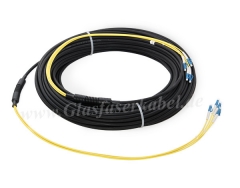
I installed fiber to connect two pv inverters at home, over a distance of 120m (to avoid equipotential bonding, through an empty conduit underground). On the one hand, fiber is a nightmare compared to Cat 7a - you have to handle it carefully, there's a pulling grip attachment that's too thick to get through most wall holes, and you can't pull too hard or the fiber will stretch beyond a certain limit and degrade. On the other hand, our cable withstood a lot of force, was bent at 120° angles, and pulled through all kinds of dirt/water without damage. I just wish that I could crimp fiber ends myself to avoid all the hassle, but the equipment is just too expensive.
It's also interesting that 25m of pre-crimped cable costs almost the same as 125m, because the crimping seems to be the expensive part, not the cable material.
You can buy some very strong fiber. My home fiber internet setup was done with some seriously good stuff. The installer left an unneeded chunk and you can't cut that with scissors without destroying them. It's some sort of outdoor rated, Kevlar reinforced thing.
For LC connectors, the two cables are held with a plastic clip, you can remove that to make it fit through smaller holes. After that it's much thinner and nicer to work with than Cat7.
The most common last-mile fiber assembly I have seen in use is called flat-drop. It is flat, and it is optimized for use on the drop to the customer premises. There are two (fiberglass?) rods and between them runs a loose tube fiber bundle with typically 6 fibers in it. Good picture here: https://www.novalight.com/Drop-Cable-Fiber-Optic-Flat-Toneab...
The fiberglass rods provide excellent crush and cut resistance, as well as bend radius control.
Our ISP installed fiber too late in the year to bury the cable, so it just laid on the ground for 7 months until thaw, right across our walkway and yard. They weren't even worried about it getting damaged.
We had fiber installed at our house and our derpy dog chewed up the line twice before they were able to bury it. Was a good time indeed and thankfully AT&T didn't charge us anything to come out and fix it each time.
They only ended up burying it a few inches deep, i was surprised and thought it would be deeper.
What surprised me the most is one of the techs telling me that ants are one of the most common threats to fiber lines outside of them accidently being severed by construction crews digging.
And my ISP had to replace mine multiple times due to lawn maintenance guys running it over, neighbors (where the line was pulled from) cutting it, etc.
I don't think I'll ever do a fiber install again. If it has already been run to the house, great, but otherwise, I'd rather not.
> For LC connectors, the two cables are held with a plastic clip...
Be careful doing that. There are LC connectors that are not capable of being split. (I know this because I attempted to split one of this type and damaged a fiber assembly at.)
The vast majority of LC connectors I've worked with can be split but some cannot.
They have special jackets on the fiber with 2 metal wires on each side. You would pull the metal wires not the fiber directly. Then you would polish the fiber and connect to the ont and turn it into an electrical signal (cat6 Ethernet). They say the max bend radius is a little larger than a coke can.
> It's also interesting that 25m of pre-crimped cable costs almost the same as 125m, because the crimping seems to be the expensive part, not the cable material.
When I was doing fiber quoting you would see this with some of the bundles, e.x. 72 vs 144. Cost wasn't doubled per foot like you'd think, it was a little less.


It's also interesting that 25m of pre-crimped cable costs almost the same as 125m, because the crimping seems to be the expensive part, not the cable material.