I have to say, this doesn't smell correct. If this is safe, than it's useless. If it provides enough power to be useful, than it's unsafe.
1) You have to sync to the grid, and if you go out of sync by more than x%, you have to automatically disconnect to protect the grid. Are they doing this? If they're not, it's because their power output is so miniscule that nobody cares.
2) You have to provide ability for line workers to guarantee that you aren't back feeding power onto a line they had turned off and so thought was safe to work on. Are they doing this, or, again, is it a don't care because they're only producing 5 watts or some equally silly power.
I imagine these devices to be so ridiculously low power, that items 1 and 2 are don't cares. However, are they so low powered that we don't even care about risk to the house itself? Plugging into a wall outlet bypasses the breaker-box in the house, Say that you're producing 10A of current with your little device. If your breakers are 15A breakers, now they won't trip until 25A of current is running through that circuit.
My gut feel is that the answer to all these questions is, nobody cares, because they produce embarrassingly low amounts of power which means they're just a way to get rich off of environmental guilt.... Thinking about it that way, I'm all for it.
Another thing is that the grid power is 3 phase. Your wall outlets are single phase or, at best two phase (for your dryer and oven). So, even if all other considerations were ignored, you're feeding unbalanced power back onto the grid, by not adding power to all three phases.
1. Nearly every house in the US is on a single 240V phase with a center-tap to create 120V. Any load is already unbalancing the three-phase transmission lines. Luckily, throwing a similar number of houses on each phase balances out. But if all the houses on one phase turned on their electric heaters and ovens and the houses on the other phases turned off everything, you'd have one unbalanced transformer, but the grid would still remain within tolerance. Now, if you picked a good 10,000 houses all on a single phase spread across a service area, maybe you'd begin to have a detectable problem.
2. Your outlets are spread semi-randomly around to each half, so if you only plugged things in one half, you could only draw half the rated power before blowing the breaker.
1. I'd be interested in where your number of 10,000 houses comes from.
2. The breakers I was referring to were your circuit breakers in your breaker box. My concern being with their ability to do their assigned task of protection.
The worst part about this is the company knows full well that their product is useless. Their entire business model is taking advantage of guilt and ignorance.
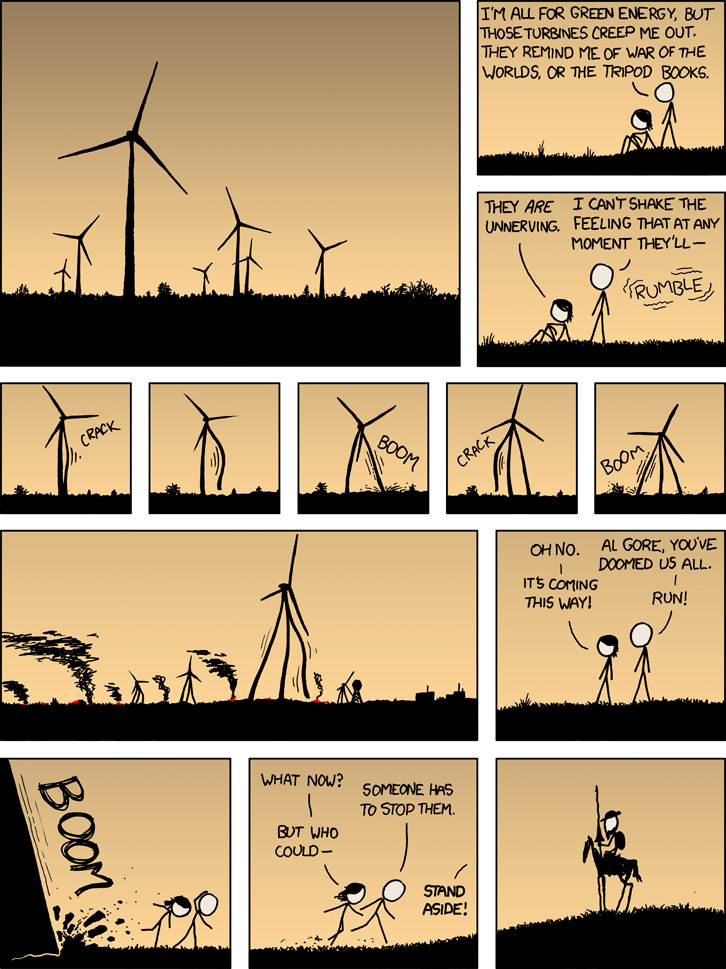
He is no Thomas Edison. So, I suppose he is a lot closer to Don Quixote.
>You have to sync to the grid ...
> You have to provide ability for line workers to guarantee that you aren't back feeding power onto a line they had turned off ...
Most solar inverters do this. It is very easy. They don't start adding power to the line until a little past a zero crossing, which solves both the sync issue and the line down issue.
> Say that you're producing 10A of current with your little device. If your breakers are 15A breakers, now they won't trip until 25A of current is running through that circuit.
Only partially true, depending on where you measure the amperage, but I doubt it'd be UL and/or NEC approved to be on anything but a dedicated circuit. If the device is the first thing after the breaker, then 25A could be flowing on the load side of the breaker. However, if it's the last thing in the circuit, the setup is completely safe. No way to assure this, of course, unless it is a dedicated circuit.
> start adding power to the line until a little past a zero crossing
That sounds technically sound. Is it compliant with power company rules? The reason I ask is that I looked into setting up a wind generation business 20 years ago, building windmills in Wyoming and selling back to the power company. The power company required special "blessed" devices between user generation equipment and the grid to protect the grid. This usually took the form of sensing circuitry and a physical relay that could completely isolate the grid from your equipment if necessary.
Doing everything in silicon with MOSFETS and algorithms is definitely technically feasible, but lacks the fail-safe behavior of physical isolation on demand. I'm surprised that they allow this.
At the macro scale, home windmills are a stupid idea. Anything can be done more economically at scale. Wind farms leverage economies of scale that don't work at home, so they can easily make more power per unit labor with the same hardware. If Jellyfish were efficient, they would be more efficiently used in wind farms.
At the micro scale, some people will buy them despite the economic inefficiency as a fell-good hobby project, but they'll never become widespread without being economical.
Also: small wind turbines make a fairly annoying constant noise. I'd vote to ban them from my neighborhood.
There are some serious advantages of building this kind of system one house a time instead of in large scale wind or solar farms.
The transmission costs, for one. If you generate the electricity in the same location it is used it is more efficient.
Also, this way the new grid can be created slowly using many small investments made by individuals instead of having to make one huge investment immediately.
It doesn't reduce the capital cost of transmission lines: you still need thick enough wire to power everyone's house when the wind isn't blowing.
If you're talking about the power loss in wires, it's only a few percent. Losses may be higher with power generated at the leaf nodes, because when my house is idle during the day it has to send power into the grid through the relatively inefficient local network while a wind farm is plugged right into the grid.
I don't think either component (wind or solar on a commodity scale in residential locations) is a good idea. Small wind turbines and solar panels are barely worth the money, even in the best locations. Most backyards (or whereever you have in mind that isn't a carefully chosen site for the technology in question) are terrible for wind and solar. It's not true everywhere-- there's a lot of wind in North Dakota, and plenty of sun in places like Arizona, but those are rarities. The vast majority of houses don't have many renewable resources available.
Just to be clear: I'm a strong proponent of large scale renewable energy; I work full-time in the solar industry. I just don't think that these products will pay back nearly as much as they will cost, even counting the carbon dioxide emissions they will save.
I talked to a guy at a party who sells rooftop solar systems here in Ohio (supposedly 75% of San Diego's sun). For up to a eight kilowatt system, 80% will be reimbursed via grants from a combination of the state and federal government. So, instead of paying $50K, I'd only pay $10K up front for a system that might last 20 years.
He said that it would generate 10,000 kwh of power per year on my roof. At about ten cents/kwh, that's about a grand. So, a 10% ROI doesn't sound too bad although I question the maintenance cost stream over the product's lifetime.
However, it's not so rosy. The power company (at least in Ohio) only must pay about three cents per kwh to the homeowner for putting power back onto the grid. So, at least some percentage of that 10% ROI gets turned into a three percent ROI.
Even at 80% off, it's still a bad deal at current pricing levels!
Yeah, and the other 40k has to come from somewhere. From what you've described, it seems like it'd never be a net win for either for you or for tax payers, even under the best conditions. Not unless the price comes way, way down anyway.


Hmmm...
I have to say, this doesn't smell correct. If this is safe, than it's useless. If it provides enough power to be useful, than it's unsafe.
1) You have to sync to the grid, and if you go out of sync by more than x%, you have to automatically disconnect to protect the grid. Are they doing this? If they're not, it's because their power output is so miniscule that nobody cares.
2) You have to provide ability for line workers to guarantee that you aren't back feeding power onto a line they had turned off and so thought was safe to work on. Are they doing this, or, again, is it a don't care because they're only producing 5 watts or some equally silly power.
I imagine these devices to be so ridiculously low power, that items 1 and 2 are don't cares. However, are they so low powered that we don't even care about risk to the house itself? Plugging into a wall outlet bypasses the breaker-box in the house, Say that you're producing 10A of current with your little device. If your breakers are 15A breakers, now they won't trip until 25A of current is running through that circuit.
My gut feel is that the answer to all these questions is, nobody cares, because they produce embarrassingly low amounts of power which means they're just a way to get rich off of environmental guilt.... Thinking about it that way, I'm all for it.